Turning Dealer Visit Notes into Automatic Performance Scores
In a distribution network, field sales reps visit dozens of dealers every week and leave a free-text note after each visit: "shelf layout looked good but stock is running low, payments are a bit delayed, the team seemed motivated." That note is valuable, but it creates three problems:
- Inconsistent grading — one rep's "good" is another rep's "average" for the exact same situation.
- Incomparability — deciding which of 50 dealers to prioritize this week is impractical from free text alone.
- Information decay — should a visit note from three months ago still carry the same weight today?
From free text to a metric pack
HuMetric feeds that note into a multi-agent pipeline driven by a Metric Pack definition:
- An extractor agent (Haiku) pulls raw observations from the visit note for every metric defined in the pack.
- A curator agent (Sonnet) merges those observations with the dealer's historical data and calibrates them — so a single visit doesn't suddenly reset the score.
- The result is a numeric metric profile that decays over time (temporal decay) and always ships with a confidence value.
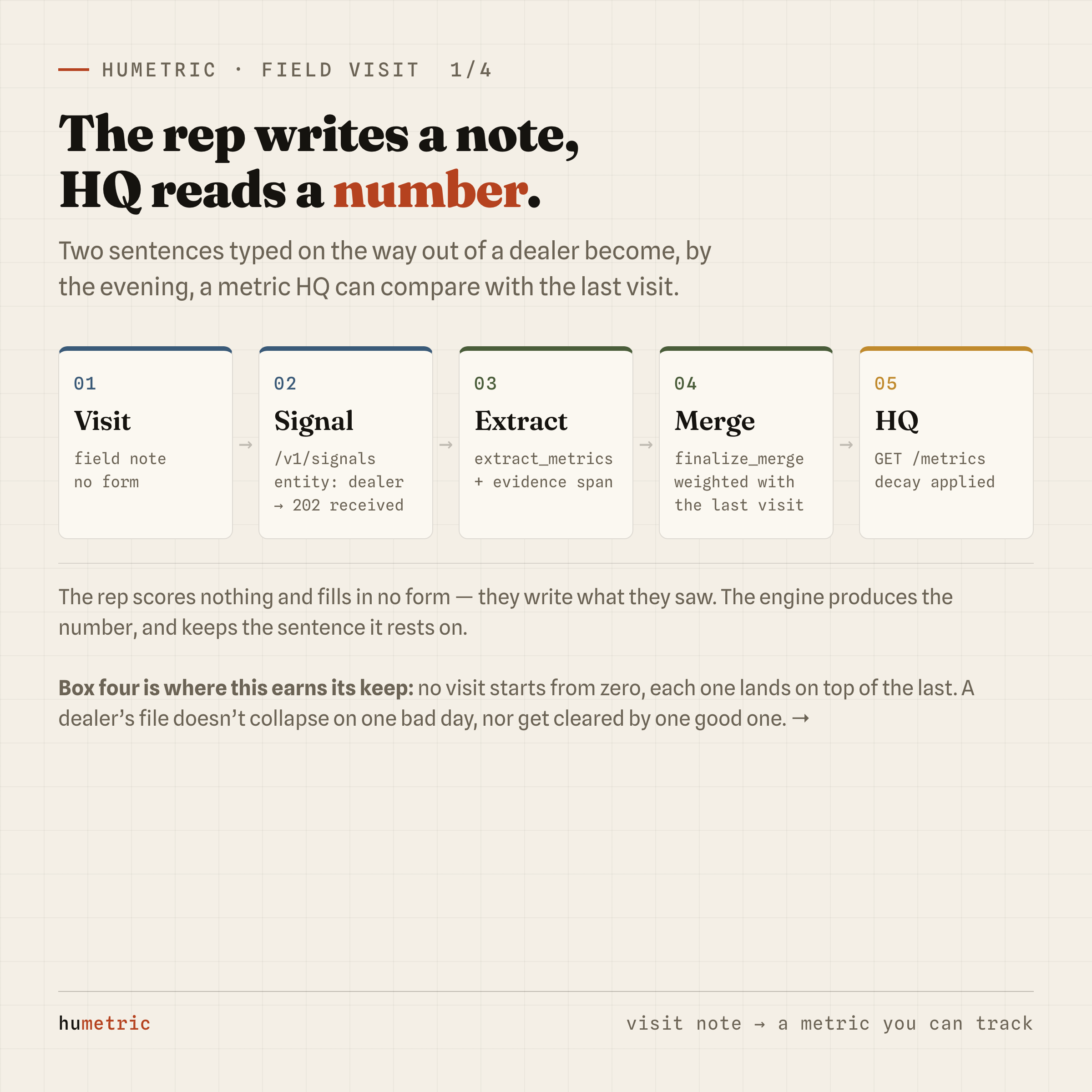
An example dealer pack (bayi-ziyaret.yaml) defines metrics such as:
- in-store execution / shelf compliance
- stock turnover
- payment discipline
- dealer team competence
- competitor pressure signal
Once the note above is processed, in-store execution goes up, stock turnover goes down, payment discipline dips slightly — each as a number with a confidence range. If no visit happens for six months, those scores don't stay frozen — they drift toward uncertainty, which bakes the question "when was this actually last checked?" directly into the score itself.
Calculate how many hours this saves your field team
Manual reporting and scoring is usually more expensive than it looks. Plug in your own numbers below:
Dealer Visit Automation Savings Calculator
This only covers reporting time — it doesn't include the opportunity cost of reps visiting the wrong dealer because of inconsistent scoring, so the real savings are usually higher.