Why Temporal Decay Beats a Static Score
Asking an LLM "read this text and grade it 1-10" is easy. But that alone isn't entity intelligence — it's just a summary of that one piece of text at that one moment. Tracking a real-world entity (a dealer, a worker, a facility) over time is missing three things:
1. Calibration: one signal shouldn't reset the score
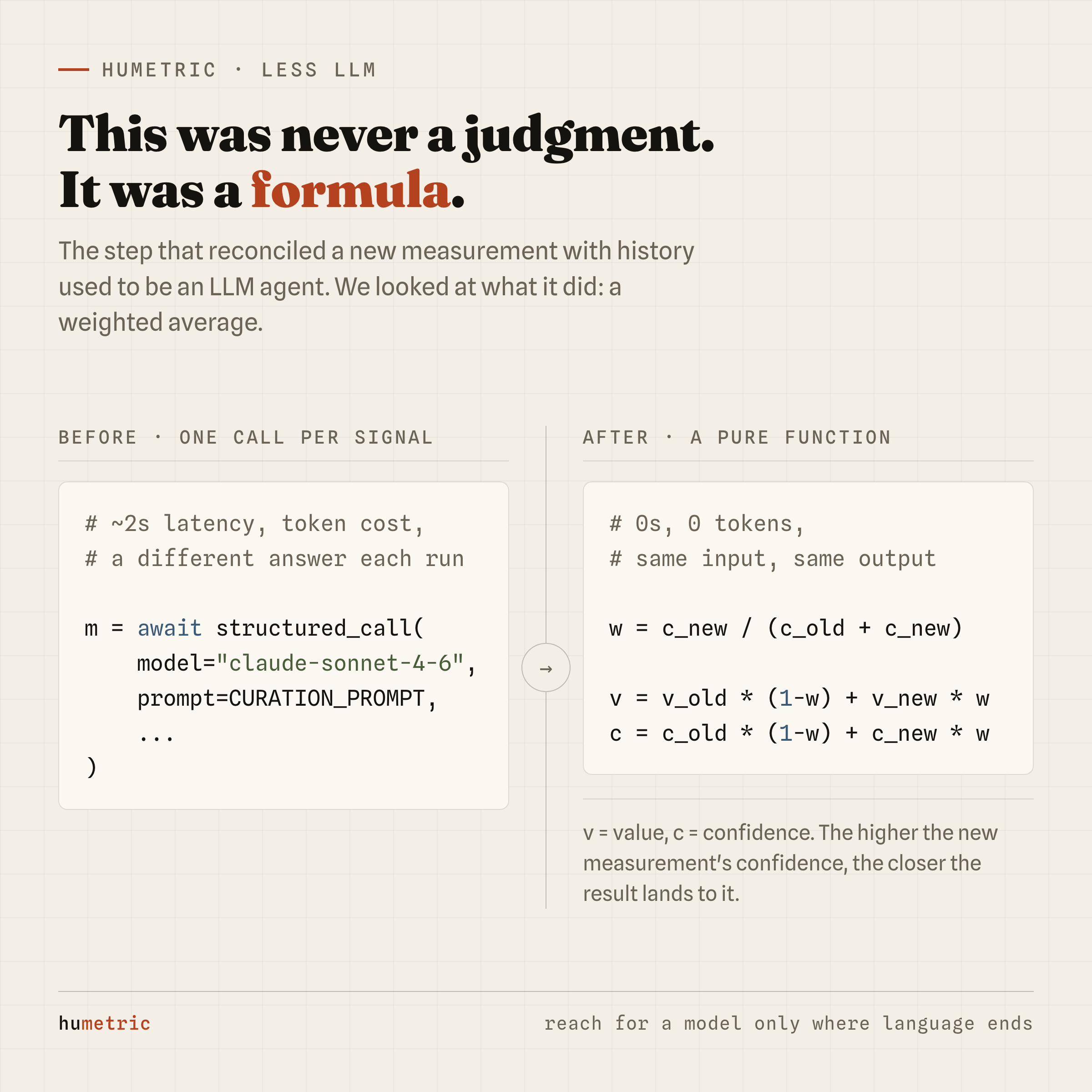
When a single customer complaint comes in, it shouldn't wipe out six months of an employee's performance history. HuMetric's curator agent merges the new observation with historical data; the score shifts based on the signal's weight and the consistency of the history, it doesn't jump. That merge isn't an LLM "judgment call" — it's a deterministic weighted average: the same input always produces the same output.
2. Evidence verification: no metric ships without a receipt
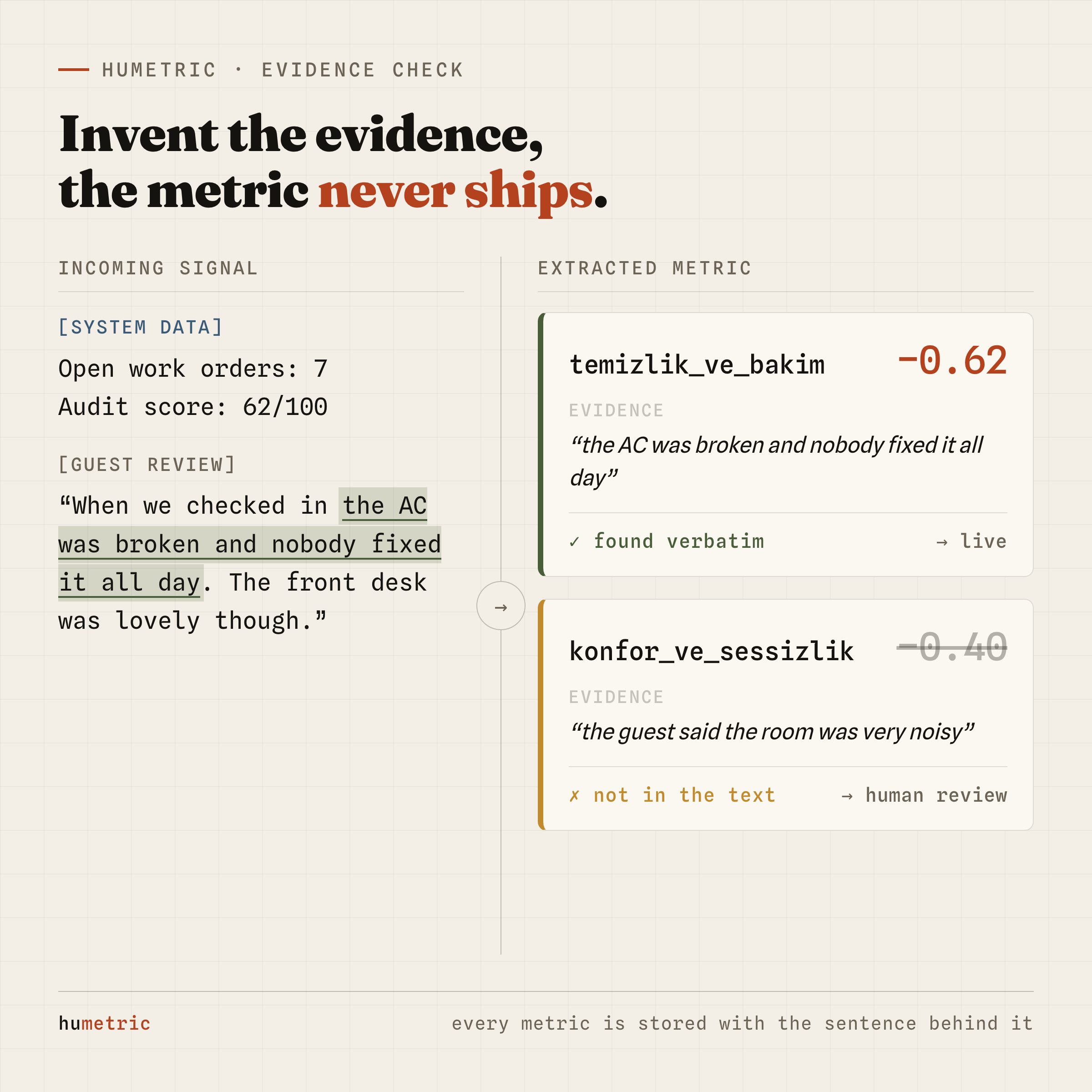
A metric only ships if the sentence it's based on is found verbatim in the source text — otherwise it drops into human review. This is a simple but effective check against a model fabricating evidence: every metric is stored together with the evidence sentence it came from.
3. Temporal decay: silence is a signal too
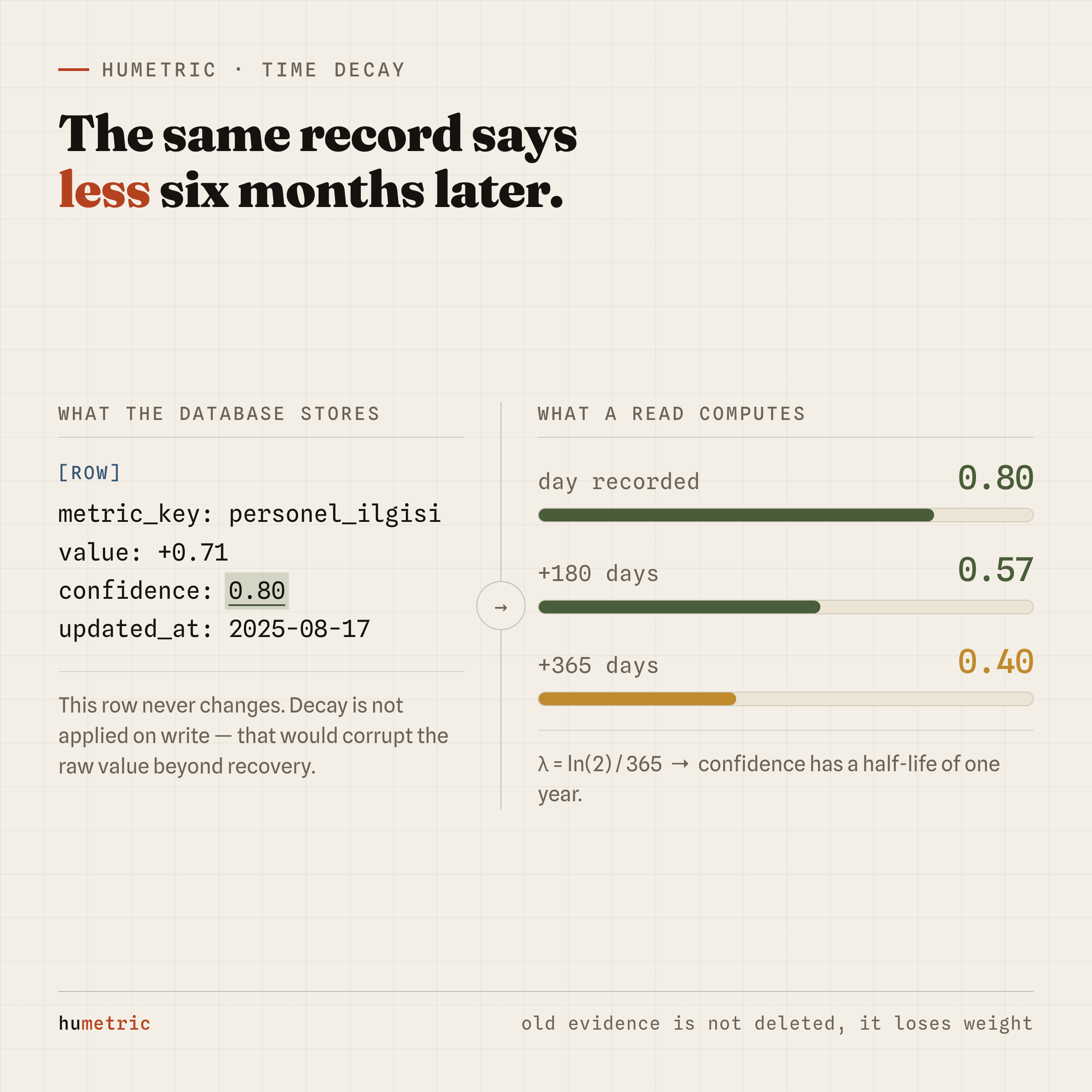
If a dealer hasn't been visited in three months, is their last known score still 100% reliable? In a static scoring system, yes — the number just sits there, frozen. In HuMetric, metrics drift toward uncertainty over time: the score itself and its accompanying confidence value both move based on how long it's been since a real observation last came in.
4. Fail-closed multi-tenant isolation
For a metric engine to be usable in practice, one tenant's data must never leak into another's. HuMetric enforces this at the database level (PostgreSQL Row-Level Security) rather than in application code: if tenant context isn't set, zero rows come back — a loud empty result instead of a silent data leak.
The takeaway
"Ask the LLM, take the number" is fine for a one-off demo. Reliably tracking an entity over weeks and months actually requires calibration, evidence verification, temporal decay, and isolation — which is exactly the problem HuMetric's Metric Pack architecture is built to solve. Here's the engine end-to-end in two minutes: